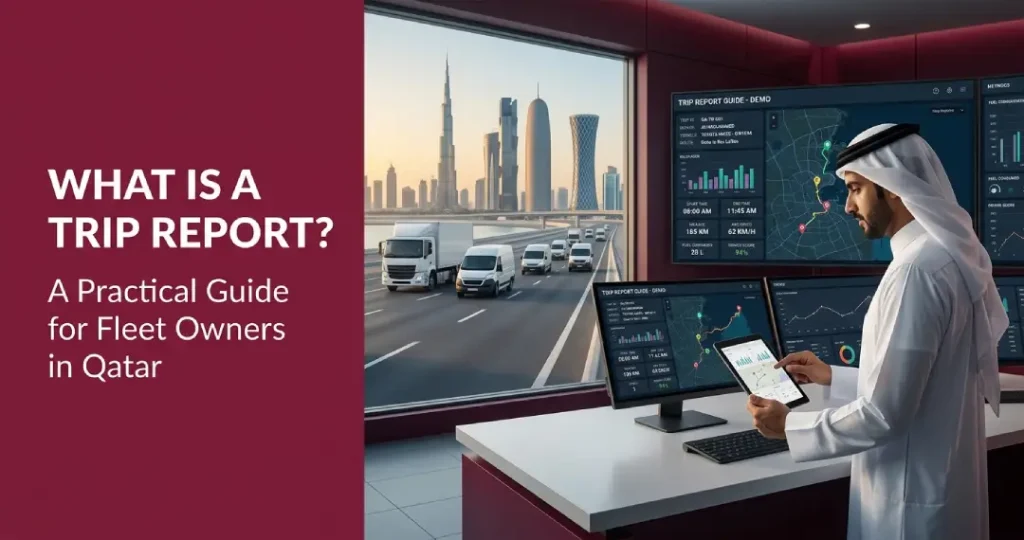
What Is a Trip Report? A Practical Guide for Fleet Owners in Qatar
Managing a fleet is not always easy. What is a Trip Report? It is a GPS tracking report that shows where a vehicle traveled, when it stopped, how far it went, and other important trip details. When a driver says they visited a customer, your accountant needs accurate mileage, or a customer claims a delivery never arrived, you do not have to rely on guesswork. A trip report gives you clear and accurate answers.
If you manage vehicles in Qatar, understanding trip reports can help you make better decisions every day. This guide explains what a trip report is, what information it includes, how to read it, and how fleet owners across Doha, Al Rayyan, and other parts of Qatar use GPS trip reports to improve efficiency, reduce costs, and solve problems with accurate data.
Offer
Special Qatar Offer – Get Premium GPS Tracking with Free Installation!
How It Works
A trip report is a GPS-generated record of a vehicle’s journey from the moment it starts moving until it stops. It shows where the trip began, the route taken, every stop made, the time spent at each stop, the total distance traveled, the average and maximum speed, and the trip’s end location.
You can think of it as a complete travel history of the vehicle. Every time a vehicle moves, the GPS tracking system records its location. The trip report turns all this GPS data into a simple, easy-to-read report, helping fleet managers track vehicle activity, verify trips, and make better business decisions.
What Information Does a Trip Report Actually Include?
Most trip reports generated by fleet tracking platforms in Qatar include some combination of the following:
- Start point and time: The exact location and timestamp the vehicle began moving
- End point and time: Where and when the trip concluded
- Route taken: The actual path driven, plotted on a map, not just a straight line between two points
- Total distance: The mileage covered during that specific trip
- Duration: How long the vehicle was actually in motion
- Stops made: Every location where the vehicle paused, along with how long it stayed there
- Idle time: Periods where the engine was running but the vehicle wasn’t moving
- Speed data: Average speed and any instances of speeding against a set threshold Driver identification which driver was assigned to or logged into the vehicle, on systems with driver ID integration
How Is a Trip Report Different From a Live Tracking View?
This is where a lot of confusion happens. Live tracking shows you where a vehicle is right now, updated every few seconds. A trip report is historical; it’s the reconstructed, organized story of a journey that has already happened, built from the location data collected along the way.
You would use live tracking to answer “where is that truck at this exact moment” You’d pull a trip report to answer “what did that truck actually do yesterday, and does it match what the driver logged?” Both rely on the same underlying GPS data, but they serve different purposes: one is operational and immediate, the other is analytical and after-the-fact.
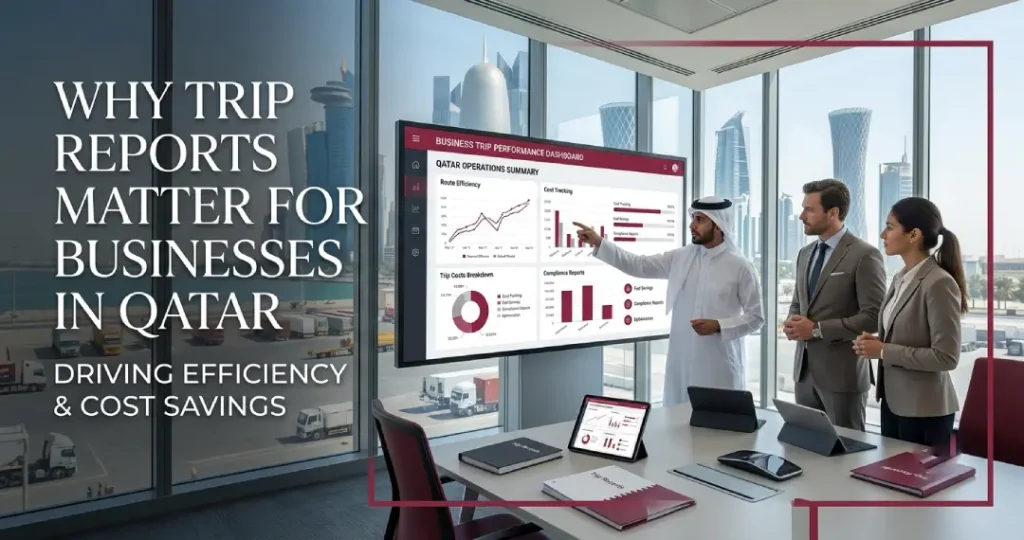
Why Trip Reports Matter for Businesses in Qatar
Settling Disputes with Facts
When a driver says they arrived on time or a customer says a delivery was late, a trip report shows what really happened. It provides the exact arrival and departure times, helping you solve disputes with accurate GPS data.
Accurate Mileage and Fuel Claims
A trip report shows the actual distance a vehicle traveled. This makes it easy to calculate fuel or mileage claims without relying on handwritten records or estimates.
Checking Time at Job Sites
Many businesses in Qatar charge customers based on the time spent at a job site. A trip report records when a vehicle arrived and left, giving you reliable proof for billing.
Finding Personal or Unauthorized Trips
Trip reports help you see if a vehicle was used for personal reasons during working hours or driven when it should have been parked.Businesses commonly use it in warehouses, hospitals, airports, shopping malls, and other indoor facilities where GPS alone cannot provide accurate tracking.
The right geo-fence depends on how your business works. A small office may only need a basic circular boundary, while a large industrial facility or construction project often benefits from a custom polygon geo-fence for greater accuracy.
Helping with Insurance Claims
If a vehicle is stolen or involved in an accident, a trip report provides useful details like the route, speed, and travel times. This information can support insurance claims and investigations.
The right geo-fence depends on how your business works. A small office may only need a basic circular boundary, while a large industrial facility or construction project often benefits from a custom polygon geo-fence for greater accuracy.
Better Routes and Lower Fuel Costs
Trip reports help you find longer routes, unnecessary stops, and delays. With this information, you can choose better routes, save fuel, and improve fleet performance.
How to Read a Trip Report
- A trip report contains a lot of information, but you only need to focus on the details that matter most.
- Start by comparing the planned route with the actual route. If the driver took a different path, check the reason. Traffic, road closures, or construction work may have caused the change.
- Next, look at how long the vehicle stopped at each location. If a stop lasted much longer than expected, it may be worth checking why.
- Also, review the idle time. If the engine was left running for long periods while the vehicle was parked, it could lead to unnecessary fuel costs.
- Finally, check the speed data. If the driver regularly exceeded the speed limit, it may indicate a safety issue that should be addressed.
Trip Reports and Qatar's Regulations
If your business uses GPS tracking in Qatar, there are two important things you should know before choosing a fleet tracking system.
First, make sure the GPS tracking devices have CRA Type Approval. The Communications Regulatory Authority (CRA) approves GPS Tracker devices that meet Qatar’s communication and safety standards. Before selecting a GPS tracking provider, confirm that their tracking devices are CRA approved.
Second, remember that trip reports may contain personal data. They record information such as a driver’s location, travel times, and routes. Under Qatar’s Personal Data Privacy Protection Law (PDPPL), businesses should collect and use this data only for legitimate business purposes and protect it from unauthorized access. It is also a good practice to explain how this data is used in company policies or employee agreements.
How Najoom Al Thuraya Can Help
At Najoom Al Thuraya, trip reporting is built into our GPS vehicle tracking platform as a standard feature, not an add-on. Every trip your fleet makes whether it’s a delivery run through central Doha or a long haul out toward Ras Laffan or Al Khor is automatically logged with route, distance, stop times, and speed data, accessible through a dashboard built for how Qatari fleets actually operate. If you’re currently relying on driver self-reporting or a basic tracking setup that only shows live location without real trip history, it’s worth seeing what a properly structured trip report actually looks like for your fleet.
FAQ's
A new trip entry is typically created every time a vehicle's engine starts and stops, meaning a vehicle making several stops in a day will generate several individual trip records rather than one combined summary.
No legitimate GPS-based trip reports are generated automatically from raw location data and timestamps, which is exactly what makes them useful as an objective record rather than a self-reported log.
Most modern systems bridge short gaps using the last known position and resume once signal returns, though a prolonged loss of signal (such as deep inside a parking structure) can create a gap in the recorded route until connectivity is restored.
No. Even a single-vehicle business, a delivery service, a contractor, or a rental operator benefits from having an objective record of mileage, timing, and route for billing, reimbursement, and dispute resolution.
This varies by provider and plan, but most platforms retain detailed trip history for 60 to 90 days, with some offering longer retention or exportable records for audit and compliance purposes.
Final Thoughts
A trip report gives you a clear record of every vehicle journey, so you no longer have to rely on guesswork or manual records. It helps you verify routes, track mileage, monitor driver activity, and resolve disputes with accurate GPS data.
For businesses in Qatar, trip reports also support better fleet management by improving efficiency, reducing fuel costs, increasing driver accountability, and helping with daily operations. Although it is just one feature of a GPS tracking system, it is one of the most valuable tools for making informed business decisions.